If You Have Eee in the Past Can You Get Again
The mosquito-borne virus Eastern equine encephalitis ramps up in Massachusetts every few years. The terminal outbreaks happened from 2010 to 2012 and from 2004 to 2006. Now it's back, and there take been four confirmed homo cases in the state as of Monday. One person who contracted EEE, a woman from Fairhaven, died over the weekend.
"In terms of mosquito numbers this year, we've exceeded the full number of positive samples we had in all of 2012," says Catherine Brown, Massachusetts' state epidemiologist.
In astringent cases, EEE can cause serious neurological impairment and can atomic number 82 to death or permanent encephalon damage. Horses seem to exist especially vulnerable, as the virus' proper name might suggest, says Scott Weaver, a virologist at the Academy of Texas Medical Co-operative.
"At that place's a feature pattern where they develop facial abnormalities, tongues hanging out, lips not behaving normally," he says. "When they exercise necropsies on horses that were infected, yous tin almost pour the brain out of the skull, it's so devastated by the viral infection."
That doesn't e'er happen to humans, though some 40% of people who practice become seriously sick from the virus die. Here are a few things to know virtually EEE and its history in New England.
Experts agree that yous should take reasonable precautionary measures to avoid mosquitoes if you lot live in a loftier-chance area for EEE
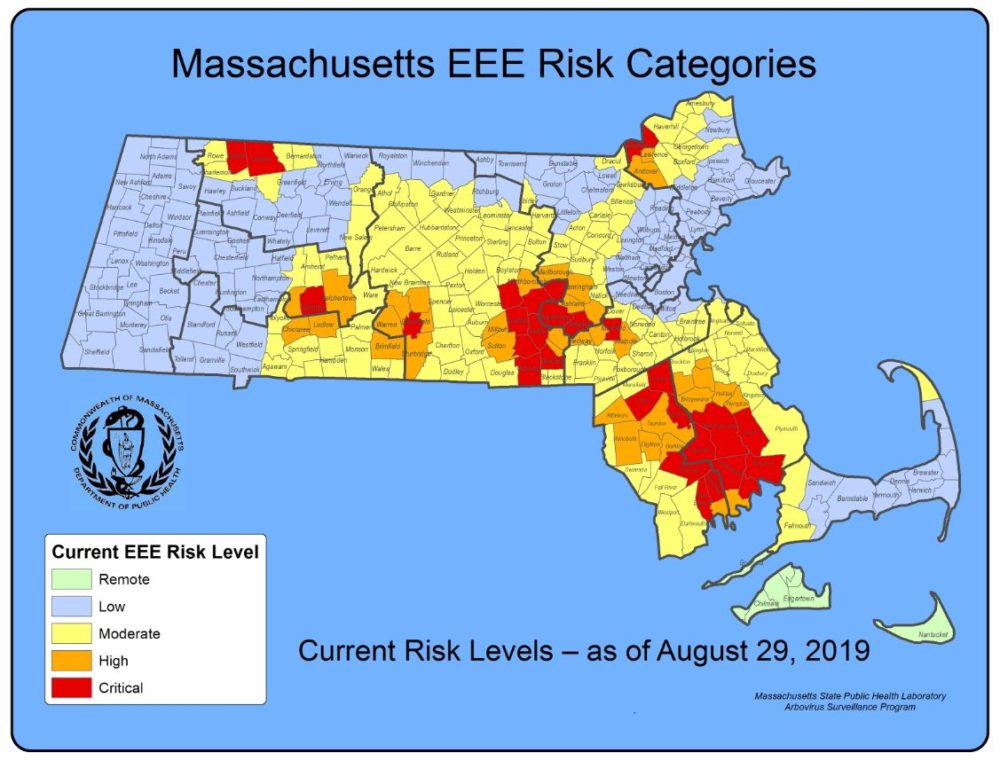
This year, areas in southeastern Massachusetts take some of the highest run a risk for EEE. If you live in whatsoever of these areas, public health officials say to avert outside activities during the hours around dawn and dusk, when mosquitoes are well-nigh active.
"Wear long clothing to protect exposed skin when the weather can permit that. Apply mosquito repellents. Dump continuing h2o," Brown says.
At that place is no known treatment or vaccine for EEE.
The disease normally begins with common symptoms such as a high fever, headache and chills, but experts warn that it tin quickly become unsafe.
"This is a affliction that invades the central nervous system, that can progress relatively speedily to changes in level of consciousness, leading to seizures, coma and well-nigh a 40% fatality rate," Chocolate-brown says.
The virus is rare, and not anybody who gets infected volition become sick
Fifty-fifty during high action periods like this one, Chocolate-brown says the disease is still very rare. During outbreak years, there are ordinarily no more than a handful of severe cases.
Some show suggests that not everyone who contracts EEE gets sick, or some people may feel only balmy symptoms. In the 1950s, New Jersey had a large outbreak of EEE, and studies from that time showed that many people had an immune response to the virus simply never became seriously ill.
"It seemed like i in 20 infections resulted in severe diseases, and the rest are balmy," Weaver says.
Those studies haven't been replicated recently, and then Weaver says there nevertheless isn't a lot of information well-nigh how many people are exposed to EEE but don't go sick.
About mosquito bites probably don't transmit the virus
"The infection rates for mosquitoes tends to exist low," Weaver says. "Unlikely more 1 in 100 mosquitoes are infected in a given region."
EEE probably evolved in South America and arrived in Northward America at least 1,500 years agone
Based on Weaver's research, EEE likely evolved several thousand years ago in the Amazon Basin in Southward America.
"We can't say for sure, but biodiversity in the tropics is greatest on all continents, so there's more opportunity for these viruses to discover a unique niche," Weaver says.
EEE is closely related to other viruses that primarily live in rodents, then Weaver thinks this virus likely starting time evolved in rodents and somewhen jumped into song birds, which are its principal hosts today. "It'southward probable that Eastern equine encephalitis virus changed from rodents to birds when it moved to Due north America," he says.
People in N America first identified the virus when it started killing horses, hence the name
"It was only a matter of time earlier in that location [were] enough people and horses around and it was really noticed," Weaver says. "[People] didn't have a way to know if the virus was there unless humans and horses were effectually to become sick."
That finally happened in 1831, when the first recorded cases of EEE resulted in the deaths of 75 horses in Massachusetts.
The threat of EEE wanes with the first frost
Information technology's hard to know just when the first common cold weather of the season volition arrive, killing off many mosquitoes. In the meantime, state officials have been spraying pesticide in areas where mosquitoes take tested positive for EEE and warning residents to have precautions to avert musquito bites.
Source: https://www.wbur.org/news/2019/08/29/eastern-equine-encephalitis-questions-answered

Post a Comment for "If You Have Eee in the Past Can You Get Again"